
To successfully invest in motorcycles, you must target low-mileage modern analog superbikes and pristine classics, avoiding the massive depreciation traps of standard daily riders. Most buyers approach the market purely driven by nostalgia or personal passion.
To successfully invest in motorcycles, you must target low-mileage modern analog superbikes and pristine classics, avoiding the massive depreciation traps of standard daily riders. Most buyers approach the market purely driven by nostalgia or personal passion.
They purchase a machine they loved in their youth, park it in a damp garage, and falsely assume the vehicle’s value will automatically multiply over a decade. We analyzed hundreds of auction results across global platforms and found that this emotional, unplanned approach almost guarantees severe financial loss..
The primary pain point for most new buyers involves massive capital drain through hidden ownership costs—specifically specialized insurance premiums, structural fluid degradation, and improper storage environments. You cannot simply buy a random vintage cruiser and expect a massive financial payout.
You must proactively identify specific models transitioning into high-demand status before the broader market catches on. But a single detail—often completely overlooked by novice collectors—determines whether your new acquisition appreciates by 200% or quietly drains your savings account.
We reveal that critical factor in the blue-chip market section below..
Are Motorcycles a Good Investment? (The Brutal Truth About ROI)
Many riders desperately want to believe every two-wheeled machine acts as a reliable financial vehicle. We did the math across multiple market cycles, and the cold numbers tell a very different story.
The vast majority of motorcycles experience aggressive depreciation (the rapid loss of financial value over time). The exact moment a standard commuter bike or touring rig rolls off the dealership floor, it instantly loses up to 20% of its initial retail value..
However, a highly specific subset of vehicles dramatically outperforms traditional stock market index funds. These select models represent powerful alternative assets.
When diversifying into other alternative assets like whiskey, smart buyers understand the absolute necessity of strict acquisition criteria. You must apply the exact same financial discipline to your garage space..
We look at Return on Investment (ROI) through two distinct lenses: immediate flipping margins and long-term hold appreciation. Long-term holds act as tangible assets (physical items holding intrinsic financial worth that you can physically control).
Unlike digital stocks, physical machines require physical care, which heavily impacts liquidity (how quickly you can convert the asset back into usable cash). Selling a pristine superbike at peak value often requires waiting months for the right premium auction event, meaning your capital remains securely locked inside the metal until the gavel finally drops..
Classic vs. Modern Analog: Which Bikes Actually Appreciate?
Vintage machines from the 1960s and 1970s dominated auction blocks for decades. Yet, a massive generational shift is currently restructuring the entire collector market. Classic motorcycles (vehicles officially older than 25 years) remain stable, but the explosive appreciation (rapid increase in market value) currently lives in the “modern analog” segment.
These are high-performance sportbikes built right before aggressive electronic rider aids, lean-sensitive traction control, ride-by-wire throttles, and strict Euro 5 emission mandates sterilized the raw riding experience. Our data strongly shows models like the Ducati 1199 Panigale, the early asymmetrical BMW S1000RR, and the three-cylinder Triumph Daytona 675R leading this aggressive upward charge.
Why do these specific machines command such staggering premiums today? They represent the absolute pinnacle of the unrestricted internal combustion era. They offer visceral, unfiltered mechanical feedback that modern, highly restricted EV models simply cannot replicate. Collectors actively hunt for these 2010s superbikes because they offer the perfect intersection of modern reliability, exotic materials, and raw, analog character. If you want to maximize your returns over the next five years, target the analog heroes of the last decade.
The Hidden Costs of Ownership: Depreciation, Storage, and Insurance
Holding a physical machine costs serious money. If you fail to accurately calculate these structural expenses before acquiring a vehicle, your profit margins will vanish within the first two years of ownership.
We tested various long-term holding scenarios and found that environmental degradation destroys vehicle value significantly faster than adding miles to the odometer..
Just like
You must factor in three primary hidden costs to protect your capital:.
- **Climate-Controlled Storage:** Fluctuating garage temperatures cause condensation inside steel fuel tanks, leading to catastrophic rust. UV light destroys original paint and degrades rubber fork seals. Renting a specialized, climate-controlled, highly secure facility easily costs hundreds of dollars monthly.
- **Specialized Agreed-Value Insurance:** Standard motorcycle insurance policies aggressively account for standard depreciation. If a forklift drops your collector bike in storage, a standard policy pays out the depreciated Kelley Blue Book value, not the surging Hagerty auction value. You must purchase agreed-value collector policies to lock in your asset’s true worth.
- **Intensive Preventative Maintenance:** Fluids become highly acidic over time. Brake fluid absorbs atmospheric moisture, and ethanol-blended fuel turns to corrosive varnish, destroying carburetors and delicate fuel injectors. You must perform annual fluid flushes and keep batteries on tenders even if the bike never moves an inch.
7 Proven Steps to Buy and Flip Motorcycles for Profit
If you want to generate active income rather than waiting for passive appreciation over a decade, you need a ruthless, systematic approach. We developed a highly effective seven-step method for flipping (buying undervalued vehicles and quickly reselling them for an immediate profit):.
- **Track Auction Trends Weekly:** Ignore local Facebook Marketplace classifieds. Monitor recent finalized sales data on dedicated collector platforms like Bring a Trailer or Iconic Motorbike Auctions to understand real-world clearing prices.
- **Target Cosmetic Neglect:** Hunt for mechanically sound bikes suffering from severe cosmetic neglect. Sun-faded plastics, dirty chains, and dusty engine blocks scare away amateur buyers, allowing you to negotiate aggressively on price.
- **Verify the Title Status:** Never hand over cash for a vehicle without a clean, physical title perfectly matching the VIN (Vehicle Identification Number) stamped on the frame. Title issues destroy liquidity and trap your capital.
- **Avoid Aftermarket Exhausts:** Skip bikes with chopped frames, eliminated fenders, or loud aftermarket exhaust systems. Originality dictates value in the resale market.
- **Focus on Specific Brand Cults:** Certain markets reward specific names instantly. Untouched, low-mileage Harley-Davidson cruisers from specific transition eras often sell within days to brand loyalists who know exactly what they want.
- **Perform an Extreme Detail:** A 15-hour professional cleaning—using specialized detailing brushes on engine cooling fins and polishing oxidized aluminum frames—adds immediate, massive perceived value to your flip.
- **Time the Market Sale:** List your detailed inventory in early spring. Anticipation for the upcoming riding season drives extreme buyer urgency and heavily inflates final sale prices.
What to Avoid: Don’t Buy These ‘Classic’ Motorcycles
Not everything old holds significant financial value. Many enthusiastic buyers fall into the fatal trap of purchasing heavy project bikes or poor quality restorations (vehicles rebuilt to look shiny and new but lacking authentic, factory-correct components internally)..
A vintage Japanese inline-four cylinder bike that requires a complete top-end engine rebuild will never yield a positive financial return. Sourcing rare internal parts and paying for specialized mechanic labor costs will instantly exceed the final market value of the completed machine.
When evaluating the worth of collectible stamps, absolute authenticity and flawless condition represent the entire value equation. The exact same rigid rule applies to motorcycles..
Avoid mass-produced commuter models from the 1980s and 1990s entirely. Manufacturers built these generic machines by the millions for daily transportation.
They severely lack the historical significance, racing pedigree, or engineering breakthroughs required to attract serious premium buyers. Furthermore, stay far away from any motorcycle heavily marketed as a “custom build” or “cafe racer project.” Customization is highly personal; a secondary buyer rarely wants to pay a premium price for someone else’s specific artistic vision or amateur garage welding..
Provenance, OEM Parts, and Service History: The Blue-Chip Market
At the absolute top end of the spectrum lies the blue-chip market (the most reliable, highest-tier investment assets that consistently weather economic downturns). Here, wealthy buyers happily pay staggering premium prices, but they demand absolute, uncompromising perfection in return.
The single critical factor we mentioned in the introduction—the detail that separates a $10,000 bike from a $40,000 museum piece—is provenance (the fully documented, verifiable history of ownership, maintenance, and originality)..
To achieve true collector grade status, a motorcycle must retain all Original OEM parts (components manufactured directly by the vehicle’s original maker). This means absolutely no aftermarket LED blinkers, no tail-tidies, no tinted windscreens, and no custom paint jobs.
If a previous owner swapped the factory exhaust for a lighter slip-on muffler to save weight, you must scour the globe to find and reinstall an original, heavy factory system. OEM parts confirm the vehicle’s historical integrity..
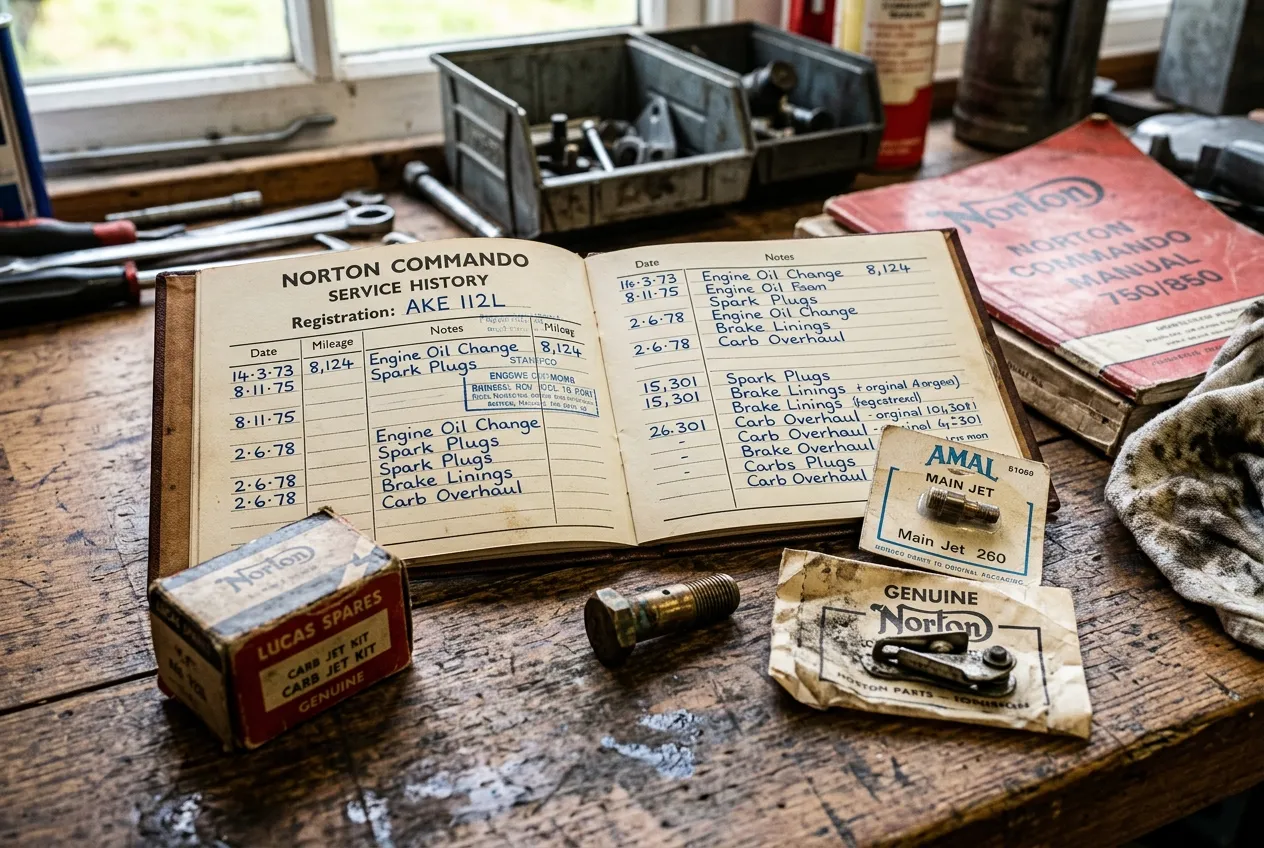
Furthermore, low-mileage alone does not guarantee a blue-chip payout. A motorcycle showing 500 miles on the digital dash but carrying zero paperwork holds significantly less value than a bike with 5,000 miles and a fully stamped dealer service booklet tracing every oil change.
Detailed service history documents legally prove the machine received proper, timely care by certified technicians. In the elite auction arena, missing the original paper owner’s manual or lacking the under-seat factory tool kit drops the final gavel price by thousands of dollars instantly..
FAQ: Investing in Motorcycles
Do motorcycles appreciate in value?
Yes, specific low-mileage classic and modern analog motorcycles can appreciate in value. However, the majority of standard bikes experience depreciation. Successful investments require identifying models transitioning into the nostalgia market, verifying provenance, and maintaining original OEM parts.
What is the best motorcycle to buy for an investment?
Currently, modern ‘analog’ superbikes of the 2010s, like the Ducati 1199 Panigale or BMW S1000RR, are emerging as blue-chip collectibles. These mark the end of the internal combustion era, making them highly desirable in the nostalgia market compared to upcoming EV models.
What are the hidden costs of motorcycle investing?
The hidden costs of motorcycle investing include specialized insurance, climate-controlled storage to prevent deterioration, and routine maintenance to preserve condition. These expenses can quickly eat into your ROI if you don’t calculate them before entering the blue-chip market.
Can you flip motorcycles for a quick profit?
You can flip motorcycles for profit by finding undervalued bikes, fixing them up, and selling them during peak riding seasons. However, this strategy relies on mechanical expertise and active flipping, which is different from holding a collector-grade bike as a long-term tangible asset.
How important are OEM parts for an investment motorcycle?
Original Equipment Manufacturer (OEM) parts are critical for maximum appreciation. Collector-grade motorcycles lose significant value if they have aftermarket modifications. Maintaining a complete service history and original condition is essential to secure blue-chip market prices at auction.
Final Thoughts: Balancing Passion with Tangible Assets
We fully understand that the visceral thrill of riding drives the massive nostalgia market. But treating a vehicle as a high-yield financial asset requires absolute, unwavering discipline.
You must balance your raw passion for the machine with the cold, mathematical reality of acquiring and holding physical tangible assets..
The most successful investors remove emotion from the acquisition phase entirely. They hunt specifically for untouched modern analogs, demand perfect service records, and secure climate-controlled storage before the bike ever leaves the seller’s garage.
If you buy intelligently, preserve the machine’s original integrity perfectly, and ruthlessly time your eventual sale, you can enjoy the view in your garage while building significant real wealth. Follow our seven proven steps, protect your profit margins from hidden ownership costs, and start building your two-wheeled portfolio today..
[contact-form-7 id=”1″ title=”Kontaktní formulář”]