✨ This article was AI edited. Editorial responsibility: Pike Speak Motorsports.
Negotiating with a Used Motorcycle Dealer: Out-the-Door Pricing, Hidden Fees & Closing Secrets
Walking into a powersports showroom without a concrete negotiation playbook is the easiest way to overpay by thousands of dollars on a pre-owned bike. Powersports dealerships operate on completely different margin structures than automobile dealers: while advertised sticker prices may look competitive online, final purchase contracts are frequently loaded with hundreds or thousands of dollars in hidden dealer fees, reconditioning charges, document fees, and inflated backend financing charges. Learning the art of negotiating used motorcycle dealer deals allows you to cut through sales tactics, eliminate bogus line items, and lock in the true Out-The-Door (OTD) market price. This comprehensive manual breaks down the dealership financial playbook and reveals exact negotiation scripts.
The Golden Rule of Motorcycle Buying: Negotiate ONLY the Out-The-Door (OTD) Price
The single biggest mistake buyers make is negotiating the advertised sale price or discussing monthly payments. Sales desk managers are trained to discount the bike by $500 on the front end while quietly adding $1,200 in administrative and preparation fees on the back end.
From your very first interaction, establish that you are negotiating strictly on the Out-The-Door (OTD) price—which represents the total, final cash figure including all taxes, government fees, and dealership charges required to walk away with the keys and title in your name.
Anatomy of a Motorcycle Dealer Buyer’s Order: Legitimate vs. Junk Fees
| Fee Line Item on Contract | Typical Dealer Charge | Legitimacy Status | Negotiation Action Strategy |
|---|---|---|---|
| State Sales Tax | 4% – 10% (State mandated) | 100% Legitimate | Non-negotiable (Fixed by state law) |
| State Title, Tag & Registration | $50 – $250 (Exact DMV cost) | 100% Legitimate | Verify against actual state DMV fee schedule |
| Dealer Document Fee (Doc Fee) | $150 – $799 | Grey Area (Dealer profit) | Capped by law in some states; negotiate an equal discount off bike price |
| Freight / Destination Charge | $400 – $900 | JUNK FEE on Used Bikes | REFUSE TO PAY: Freight is paid only once on new OEM bikes from factory |
| Reconditioning / Prep Fee | $350 – $800 | JUNK FEE | REFUSE TO PAY: Reconditioning is standard overhead cost of doing business |
| Battery & Tire Hazard Protection | $295 – $595 | Dealer Add-On | Demand immediate removal from contract |
| GPS Tracking / Security Etching | $395 – $695 | Dealer Add-On | Demand immediate removal from contract |
Step-by-Step Negotiation Strategy: From Online Research to Signing
Step 1: Secure Pre-Approved Financing Before Visiting
Never rely solely on dealership financing. Obtain a pre-approved motorcycle loan draft from your local credit union (where rates are often 4% to 8% lower than dealership captive lenders). Having pre-approval gives you cash-buyer leverage and forces the dealer finance manager to beat your rate to earn the finance reserve.
Step 2: Benchmark Market Values with Closed Comps
Before stepping into the showroom, pull clean trade-in and retail valuation reports from J.D. Power (NADA Guides) Powersports and Kelley Blue Book (KBB). Bookmark 2 to 3 identical make/model/year motorcycles for sale within a 150-mile radius on CycleTrader to establish competitive pressure.
Step 3: Conduct a Meticulous 15-Minute Mechanical Inspection
Perform a thorough physical check before talking price. Point out every cosmetic blemish and maintenance need to build leverage for price reductions:
- Tire Age & Tread: Check the 4-digit DOT date stamp on the sidewall. Tires older than 5 years or under 3/32″ tread represent a mandatory $350–$500 immediate replacement expense.
- Chain and Sprockets: Check for hooked sprocket teeth, stiff chain links, and rust ($250 replacement).
- Fork Seals: Run a clean finger around the chrome fork stanchions. Any oily residue indicates blown fork seals ($300–$450 shop repair).
- Brake Rotors & Fluid: Inspect rotor scoring and brake fluid color (dark tea-colored fluid indicates neglected maintenance).
The 4 Dealer Sales Tactics and How to Counter Them
Tactic 1: “We have another buyer coming to see this bike this afternoon.”
The Counter: “That is great for you, but I am standing right here with funds ready to buy right now at a fair out-the-door number. If you cannot do $7,200 OTD today, give the other buyer a call and let me know if it falls through.” (Be completely prepared to walk away—dealers will often call you before you reach your car).
Tactic 2: “Freight and prep are non-negotiable fees charged on every bike.”
The Counter: “I understand your store policy, but freight was already paid when this motorcycle was delivered new years ago, and reconditioning is your standard cost of acquiring inventory. I will not pay freight or prep on a pre-owned vehicle. If you cannot remove those line items or discount the base price by that amount, we don’t have a deal.”
Tactic 3: “What monthly payment are you looking to hit?”
The Counter: “I am not discussing monthly payments. I am paying for this motorcycle based on the total Out-The-Door price. Let’s agree on the final OTD number first, and then we can look at financing terms.”
Navigating the Finance & Insurance (F&I) Office
Once you agree on the price with the sales manager, you will be escorted into the F&I office to sign the final paperwork. The finance manager will attempt to sell you high-margin backend products:
- Extended Warranties: Often marked up 200% to 300%. If you want extended warranty coverage on a complex modern motorcycle, negotiate the warranty price down by 50% or buy third-party coverage directly from your credit union.
- GAP Insurance: Essential if you are putting less than 20% down, but dealerships charge $800 to $1,200. Check with your motorcycle auto insurer first, where GAP coverage is often available for just $3 to $5 per month.
- Tire & Wheel Protection: Only worth considering if the bike has delicate high-cost forged wheels and you ride in heavy pothole urban environments; otherwise decline.
Frequently Asked Questions (FAQ)
When is the best time of year to negotiate with a used motorcycle dealer?
The best time to negotiate is between November and February in cold climates when dealer foot traffic drops dramatically and floor plan interest costs accumulate on sitting inventory. Additionally, shopping during the last 3 business days of any month allows you to capitalize on monthly sales quotas.
Can you negotiate the price of a used motorcycle at CarMax or no-haggle dealers?
At strictly no-haggle retailers like CarMax, vehicle sale prices are fixed. However, you can still negotiate your trade-in allowance, challenge document fees where state law permits, and refuse optional backend protection plans.
Is it rude to make a lowball offer on a motorcycle?
No. A respectful, data-backed opening offer 15% to 20% below asking price is standard business practice. As long as you remain polite, professional, and ready to transact, dealerships expect counteroffers.
What paperwork should I walk away with after buying a used motorcycle?
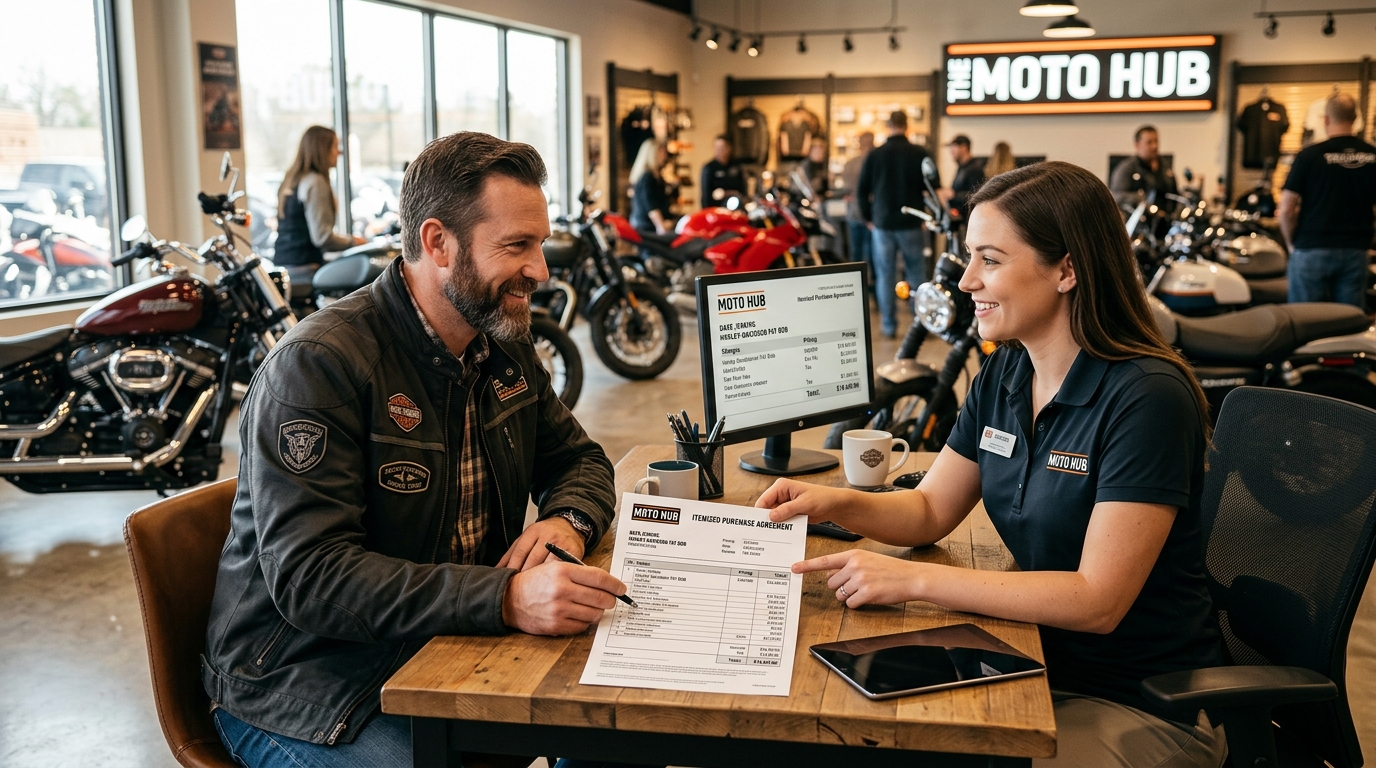
You must receive an itemized copy of the signed Buyer’s Order / Bill of Sale, temporary registration/tag permit, odometer disclosure statement, finance contract (if financed), and proof of state safety inspection.